B42 Crafting Overhaul: Surviving the Apocalypse One Skill at a Time (Build 42.19)
Vanilla Build 42.19 · official preset defaults · recipe thresholds, materials, and XP values may change in later patches
Build 42 expanded Project Zomboid’s crafting system into a denser web of skills, stations, and media unlocks. Progress still rewards reading and building, but the old mental model—“read a skill book, unlock recipes, dismantle furniture for free Woodwork XP, spam poles from level 0”—does not match 42.19. This page is a skill-by-skill survival map for current Build 42 crafting, not a dump of every recipe name.
Core rules that trip players up
Skill books raise XP multipliers; magazines unlock recipes
Ordinary skill books (Carpentry I–V, Cooking I–V, Maintenance I–V, and the rest of the skill-book set) train a skill over a level band and set the XP multiplier for that band. They do not teach individual recipes. Recipe magazines and similar literature are the usual source of specific unlocks. Example: Smithing Mag 1 grants recipes such as Make Crude Whetstone, tongs, nails, and several forge tools.
Furniture dismantling still has XP rules—defaults often give zero Woodwork XP
Dismantling can still award skill XP, but whether you receive it depends on the sandbox option
Maximum Dismantling XP Level (LevelForDismantleXPCutoff).
When a skill is at that level or above, scrapping furniture does not provide XP for that skill. Electrical is exempt.
In the Build 42.19 Apocalypse, Outbreak, Rising, and Extinction presets, that cutoff is 0.
That means default worlds do not award Woodwork XP for furniture scrap, because your Woodwork level is never below 0.
Raise the cutoff if you want dismantle training back. Do not assume “B42 deleted dismantle XP entirely”—the option is still there.
Do not edit game recipe files to “fix” the game
Getting started: tools, stations, first builds
Essential tools and resources
- Basic tools: hammer, saw, screwdriver, and a knife or other cutting tool (hardware-store loot routes help).
- Stations: workbench-style surfaces for many recipes; later, forge, kiln, pottery wheel, and specialized outdoor stations.
- Materials: planks, nails, metal scrap, clay, sand, fabric, stone, fuel.
- Media: skill books for multipliers; magazines for recipe unlocks where required.
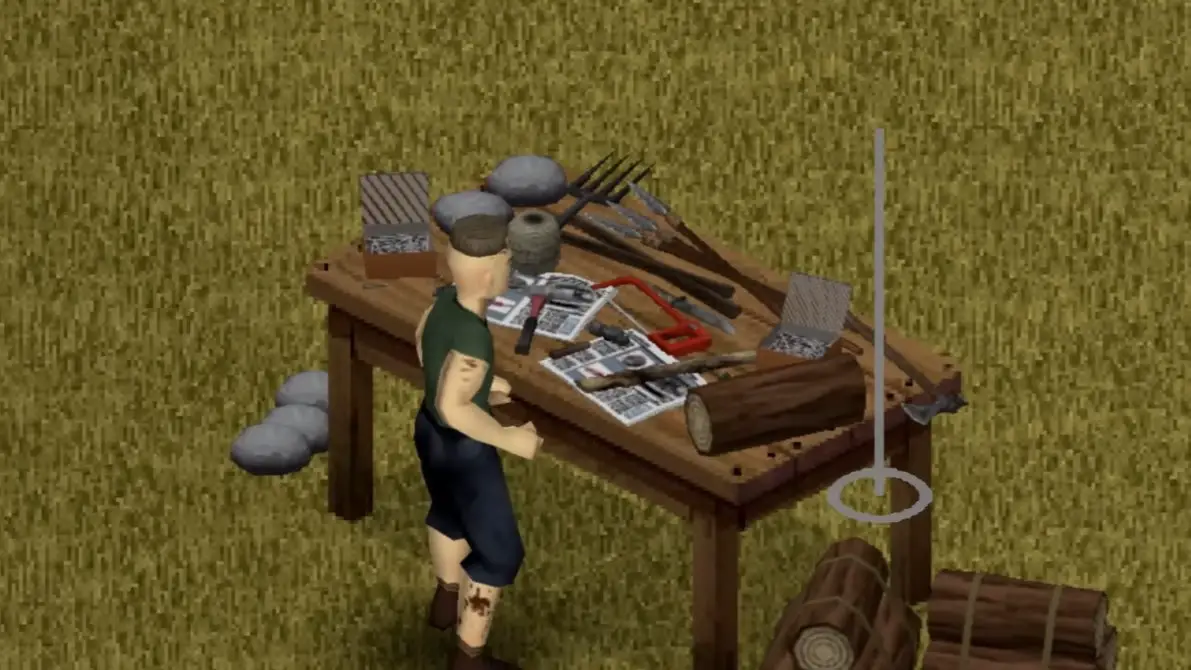
Skills chain. Pottery crucibles support metal work; carpentry builds many early stations; knapping and carving cover tools before you own a full workshop.
First projects that match 42.19 thresholds
| Project | Skill gate (42.19) | Materials / notes | XP |
|---|---|---|---|
| Wood floor (level 1) | Woodwork 1 | Hammer (kept), 1 plank, 1 nail | Woodwork 10 |
| Wooden Pole | Woodwork 2 | Hammer (kept), 1 plank, 1 nail | Woodwork 20 |
| Rain collector (bag version) | Woodwork 3 | Hammer, 4 planks, 4 nails, 4 garbage bags | Varies by recipe |
| Rain collector (tarp version) | Woodwork 3 | Hammer, 4 planks, 4 nails, 1 tarp | Varies by recipe |
| Carpentry crate (basic) | Woodwork 3 | Hammer, 4 planks, 4 nails | Woodwork 30 |
| Make Crude Whetstone | Maintenance 1 (auto-learn at Maintenance 2) | 2 × stone; must learn recipe (magazine or auto-learn) | Maintenance 5 |
Wooden poles are efficient once you already have Woodwork 2—they are not a level-0 spam starter. Until then, use Woodwork 1 builds such as basic floors, low furniture, and other early props, plus skill-book multipliers.
Common early mistakes
- Treating skill books as recipe unlocks instead of XP multipliers.
- Planning poles before Woodwork 2.
- Expecting furniture dismantling to train Woodwork on default sandbox values.
- Skipping magazines for blacksmithing, vehicle types, and other gated crafts.
- Editing install files because a recipe looked broken in an older patch.
Maintenance: keep gear usable
Maintenance supports tool and weapon longevity. In current repair and sharpen recipes, Maintenance XP is awarded on those actions when the recipe lists it—not as an undocumented “always best under 50% condition” rule.
How to train it
- Read Maintenance skill books for the correct level bands (multiplier only).
- Repair and sharpen with the recipes you know—files, whetstones, grinding tools, and related fixing recipes grant Maintenance XP when the recipe awards it.
- For crude whetstones: learn Make Crude Whetstone (Smithing Mag 1 includes it) or reach Maintenance 2 for auto-learn; cost is two stones and Maintenance 1.
Practical tips
- Specialize one primary weapon so repair materials stay predictable.
- Stock Electronic Scrap and metal scraps where electrical or metal repairs require them.
- Use grinding/sharpening tools carefully—some sharpen actions can degrade tools further on failure.
Carpentry (Woodwork): build, do not assume free scrap XP
Carpentry still underpins bases, water collectors, and many stations.
Leveling path that matches defaults
- Read Carpentry skill books for the band you are training.
- Build Woodwork 1 structures (floors, basic furniture, early outdoor props) until Woodwork 2.
- Add Wooden Poles (1 plank + 1 nail + hammer, Woodwork 2, 20 XP) as a compact XP sink.
- Move into crates, barricades, rain collectors, and higher walls as thresholds unlock.
On default 42.19 presets, furniture dismantling does not train Woodwork. Raise LevelForDismantleXPCutoff only if you want that loop. Electrical dismantling remains an exception.
Priority builds
- Rain collectors at Woodwork 3 (bags or tarp variants—do not omit the membrane materials).
- Storage crates and work surfaces for material flow.
- Walls, barricades, and defensive frames as skill and nails allow.
Carving: low setup, high early value
Carving needs little infrastructure: a cutting tool and wood.
- Read carving skill books for multipliers.
- Carry a knife (stone knives work early).
- Process branches, saplings, and logs into stakes, spears, handles, and simple utensils as recipes allow.
Good pairing with foraging and early combat spears before a full forge exists.
Cooking and butchering
Cooking still rewards books plus actual cooked dishes. Eggs and simple cooked meals remain easy practice food when you have a heat source; more complex recipes add nutrition and preservation options. When butchering animals, keep bones and other by-products if your recipes or skills use them—do not treat “bones = guaranteed huge Butcher XP every time” as a universal constant; check the XP the active butcher action shows.
- Preserve with smoking, drying, salting, or cold storage when you have the stations.
- Balance calories and boredom for long runs—not only raw hunger.
- See also the broader food guide.
Electrical
Electrical still levels mainly by dismantling electronics and building simple powered setups. Generator knowledge is not “Electrical 3 automatically”—use the Electronics magazine path or occupations that already know generators (see generator guides for 42.19 detail).
- Generator placement and repair
- Lighting and refrigeration once power is stable
- Keep scrap electronics for repair recipes
Glassmaking
Glassmaking is a long chain: sand, clay tooling, furnace heat, molds, and related media. Expect scavenged sculpting tools and clay work before reliable panes or jars. Treat decorative glass as a luxury; prioritize windows and storage only after fuel and safety are solved.
Knapping (Flint Knapping)
- Read knapping skill books for multipliers.
- Gather suitable stone/flint and a hard knapping tool.
- Start with flakes and simple blades; move into larger heads when the skill and recipes unlock.
Stone knives and early axe heads bridge the gap when metal tools are scarce.
Masonry
Masonry supports durable structures and some furnace/oven paths. Expect chisels, trowels, clay, brick, and cement-style materials depending on the recipe. Many starter tools can be forged or knapped rather than found as finished goods.
Metalworking / blacksmithing
Metalworking is station-heavy: forge, furnace, kiln, charcoal, and heat management. Skill books raise learning speed; smithing magazines unlock named forge recipes.
- Stand up primitive heat sources and an anvil path your save can actually feed with the correct fuel types.
- Read smithing magazines before assuming tongs, files, or whetstone crafts are known.
- Smelt junk metal into workable stock, then forge tools and weapon parts.
- Keep charcoal production (pit or barrel methods) near the forge to avoid fuel bottlenecks.
Mid-level mass crafts (for example buckle-style small metal items when they are available to you) can be efficient XP, but always confirm skill requirements and steel cost in the live craft menu—do not trust outdated “level 4–5 only” lore without checking.
For deeper forge loops, see metalworking tips.
Mechanics
Mechanics still rewards systematic part swaps on wrecks and road cars. Vehicle-type magazines matter: standard, sports, and heavy-duty knowledge is media-gated more than “just click repair.” Keep a parts car, a tool roll, and spare tires/batteries before long road trips. Bookstores and auto shops remain priority loot for books and magazines.
Pottery
- Build pottery bench/wheel capacity with enough carpentry.
- Read pottery skill books for multipliers; learn specific recipes if the menu marks them unknown.
- Gather clay near wet natural tiles; fire/cure pieces in a kiln when required.
- Prioritize crucibles and storage vessels that unlock other industries.
Tailoring
Tailoring still uses rags, thread, needles, and patches. In 42.19, Pick Thread requires Tailoring 1, rips/denim strips, and a needle/tweezers/awl—you do not get free thread by casually tearing clothes the B41 way. Reach Tailoring 1 via looted thread, simple clothing modifications, or other low recipes, then salvage thread and pad armor for bite/scratch protection.
Metalworking weld path (propane welding)
Propane torch, fuel, and a welder’s mask still gate many metal structure recipes. Dismantle wrecks for metal sheets and pipes, then reinforce doors, bars, and frames. Tools are largely loot-dependent early; plan auto-shop and warehouse runs.
Weapons through crafting
Early
- Looted one-handed blunts: pipes, hammers, wrenches, pans, tire irons—common and reliable (scrap weapons overview).
- Carved spears for reach.
- Knapped knives and simple stone axes when metal is scarce.
Mid to late
- Forged blades and reinforced blunt weapons once metalworking stations and magazines are online.
- Magazine-gated hybrid weapons—always verify skill requirements and magazine names in your build; community nicknames rotate faster than the live craft menu.
- Sharpen and repair finished weapons with known Maintenance recipes rather than improvising install edits.
Lower condition can hurt effective performance. Prefer controlled sharpen/repair loops and keep backups. See weapon repair for material tables.
Known issues: what still matters in 42.19
Crude whetstone (fixed in stock recipes)
Current Make Crude Whetstone consumes two stones, requires Maintenance 1, awards Maintenance 5, needs to be learned, and auto-learns at Maintenance 2. Do not apply old double-item syntax patches to generated recipe files.
Fuel and anvil/forge edge cases
If a heat recipe rejects your charcoal or anvil path, check the exact items and tags the craft menu wants before assuming a permanent bug. Force-spawning items is for testing only—it is not a survival strategy and can spoil multiplayer integrity.
Other practical workarounds (non-destructive)
- Missing magazines: raise loot rarity only as a conscious sandbox choice, or farm bookstores, classrooms, and profession-themed containers.
- Thread: use Pick Thread at Tailoring 1 or loot spools; do not expect B41 tear-for-thread behavior.
- Butchering: follow the active butcher UI and the XP it shows; keep by-products you will actually use.
Putting skills together
Seasonal focus
- Spring / summer: food preservation, outdoor stations, farming support builds.
- Fall: clothing insulation, indoor lit craft spaces, material stockpiles.
- Winter: indoor tailoring/repair, tool maintenance, comfort items during low-mobility days.
Useful pipelines
- Food line: carpentry structures → foraging/farming → cooking → pottery storage.
- Weapon line: knapping/carving → metalworking blades → maintenance longevity.
- Power line: electrical scrap → generator knowledge → safe outdoor generator placement.
Base capability by broad skill bands
| Band | What you can usually support |
|---|---|
| Levels 1–3 | Basic wood structures, early storage, simple water collection, starter stations |
| Levels 4–6 | Stronger barriers, specialized craft rooms, more reliable food/water loops |
| Levels 7–10 | Heavy fortification, advanced production, comfort and quality-of-life systems |
Key takeaways
- Books ≠ magazines: skill books multiply XP; magazines (and some auto-learn rules) unlock recipes.
- Wooden Pole is Woodwork 2: 1 plank, 1 nail, hammer kept, 20 Woodwork XP—not a day-one freebie.
- Default dismantle XP for Woodwork is off at cutoff 0; the option still exists and Electrical is special-cased.
- Maintenance XP is clearest on repair/sharpen recipes—do not rely on folklore thresholds.
- Never “fix” crafting by hand-editing generated scripts in a normal play install; 42.19 already ships a valid crude whetstone recipe.
- Verify in the live craft menu after each unstable update—thresholds and magazine lists move.
Next steps
- Pick two or three complementary skills (for example Woodwork + Cooking + Maintenance).
- Secure a base with room for stations.
- Prioritize the matching skill books and the magazines those crafts actually reference.
- Expand into pottery, metal, and electrical only when the stations and media are online.
Build 42.19 already treats crafting as a long systems game: multipliers, media unlocks, sandbox XP gates, and station chains. Build for the recipes you see in the craft menu, keep backups of valuable saves, and leave the install’s recipe files alone.
Related Articles