How to Stitch Deep Wounds in Project Zomboid (Build 42.19)
Health Panel · Build 42.19 · First Aid skill
Stitching closes the wound; it does not guarantee a clean recovery
A deep wound needs closing so bleeding and healing time can improve, but every stitch attempt can still leave a local Infected Wound on that body part. Higher First Aid lowers that chance. Disinfectant, clean or sterilized dressings, and swapping dirty bandages are the real infection-control loop.
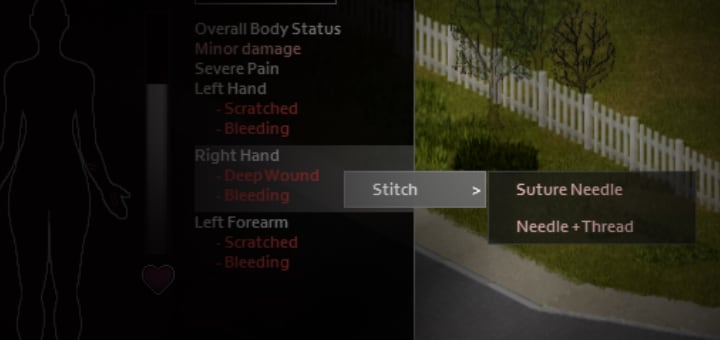
Deep wounds show on the Health Panel as a separate injury. Treat them from the same panel: open the injured body part, use the context actions, and work in order. For the full injury table, see the First Aid guide and the medical supplies list.
What you need
 Suture Needle
Best single item for stitch
Suture Needle
Best single item for stitch
 Needle + Thread
Sewing needle and thread work
Needle + Thread
Sewing needle and thread work
 Suture Needle Holder
Faster, less painful stitch
Suture Needle Holder
Faster, less painful stitch
 Tweezers / holder
Remove lodged glass first
Tweezers / holder
Remove lodged glass first
 Disinfectant / alcohol
Cleans the wound site
Disinfectant / alcohol
Cleans the wound site
 Clean bandage
Cover after stitching
Clean bandage
Cover after stitching
| Tool option | Items | Notes (Build 42.19) |
|---|---|---|
| Preferred stitch | Suture Needle | One item closes the deep wound. Counts as a proper suture tool for speed and pain reduction. |
| Field stitch | Sewing needle + Thread (or similar fiber) | Works when you lack medical suture needles. A holder in inventory still speeds the action and cuts pain. |
| Helper tool | Suture Needle Holder | In inventory during stitch: action is faster (about 150 vs base 200 before First Aid), and stitch pain is lower (about 10 vs base 20). |
| Glass removal | Tweezers, Suture Needle Holder, other glass-removal tools, or bare hands | Stitch is hidden while glass remains. Hands work but add extra pain and take longer. |
Treatment order on the Health Panel
- Stop life-threatening bleeding first if another body part is pouring blood. Deep wounds matter, but uncontrolled bleeding kills faster.
- Remove lodged glass when the panel shows glass shards. With glass present, Stitch does not appear.
- Disinfect with alcohol-based disinfectant, alcohol, or other valid alcohol items when you have them. This cleans the site and can add short-term pain.
- Stitch with a Suture Needle, or a sewing needle plus thread. Keep a Suture Needle Holder in inventory when you can.
- Bandage with a clean or sterilized dressing. Dirty bandages still cover the wound but protect poorly and raise infection risk—replace them as soon as you can.
- Monitor for Infected Wound on that body part. Treat local infection with clean/sterilized care, disinfectant, and antibiotics if needed—this is not zombie infection.
- Remove stitches later from the same panel once the stitched site has had time to improve. Higher First Aid improves stitch quality over time, and First Aid above 6 can show readiness cues on the panel.
Glass blocks stitching
If the Health Panel lists lodged glass, pull it first with tweezers, a Suture Needle Holder, another glass-removal tool, or hands. Hands always work, but they take longer and add more pain.
First Aid, pain, time, and infection chance
Stitch scales with your First Aid level. Better skill shortens the action, lowers extra pain, improves how quickly the stitch is ready to remove, and reduces the chance that the action itself marks the wound as infected.
| Effect | How it scales |
|---|---|
| Action duration | Base about 200, or 150 with a Suture Needle or Suture Needle Holder; then First Aid shortens it further (roughly −4 per level). |
| Extra pain on stitch | Base about 20 (about 10 with a Suture Needle or holder), then First Aid reduces the remainder (minimum 0). Hemophobic characters also gain panic. |
| Stitch quality timer | Higher First Aid reaches a removable, well-healed stitch faster. Expect a multi-day wait that scales up with skill. |
| Wound infection on the action | Each stitch or remove-stitch completion has a chance to set Infected Wound. Roughly 1 in 5 at First Aid 0, down to about 3% at First Aid 10. |
| First Aid XP | A successful first stitch on a part that still awards stitch XP grants 15 First Aid XP. |
Infection control is mostly aftercare
Closing the wound is required for deep wounds, but local infection risk stays with dirty dressings, a poorly cleaned site, and unlucky stitch rolls. Prefer sterilized bandages or disinfectant when the part looks dirty or already infected, and change soiled dressings promptly.
Local wound infection is not Knox infection
Do not confuse these two systems
- Infected Wound is a body-part flag. It comes from dirty care, unlucky stitch rolls, and similar first-aid failures. Treat it with clean dressings, disinfectant, antibiotics, and rest.
- Zombie / Knox infection is a separate transmission path (default Apocalypse: blood and saliva, multi-day mortality). Bandages and stitches manage bleeding and surface healing only. Antibiotics fight wound infection and do not stop zombification.
- Armor and careful fighting reduce scratches, lacerations, and bites. Stitching only closes a deep wound after the injury already happened; it does not reverse Knox transmission.
When to remove stitches
- The Health Panel offers Remove Stitch while the part is still stitched.
- With First Aid above 6, the panel can show whether the stitch is ready to come out.
- Removing stitches also applies a small pain spike and uses a similar infection roll, so wait until the wound has clearly improved when you can.
- After removal, keep a clean bandage on the site if the panel still shows an open or recovering injury.
Quick field checklist
- Safe room or cleared space—do not stitch while a chase is active.
- Glass out → disinfect if available → stitch → clean bandage.
- Carry at least one Suture Needle (or needle + thread) and a holder or tweezers in the medical bag.
- Watch the body part for Infected Wound and dirty dressings over the next hours and days.
- If the injury was a zombie bite or scratch under infectious rules, first aid still only handles the wound surface—track Knox progression separately.
Related medical guides
Related Articles
Project Zomboid Medical Supplies (Build 42.19)
First Aid Kit Breakdown: Stop Zomboid Wounds From Killing You (Build 42.19)
Project Zomboid Burn Treatment (Build 42.19) & Burn Ward Patient Mod
How to Heal a Fracture in Project Zomboid (Build 42.19)
Project Zomboid First Aid Guide (Build 42.19)
How to Make Sterilized Bandages in Project Zomboid (Build 42.19)