How to Heal a Fracture in Project Zomboid (Build 42.19)
Build 42.19 · limbs only for splints · First Aid sets the speed-up · Comfrey is an extra boost
- Open the Health panel and find the red Fracture line on a limb.
- Carry a ready Splint, or Ripped Sheets plus a Plank, Tree Branch, or Wooden Stick.
- Right-click that body part → Splint and pick your materials. You cannot splint the head or torso.
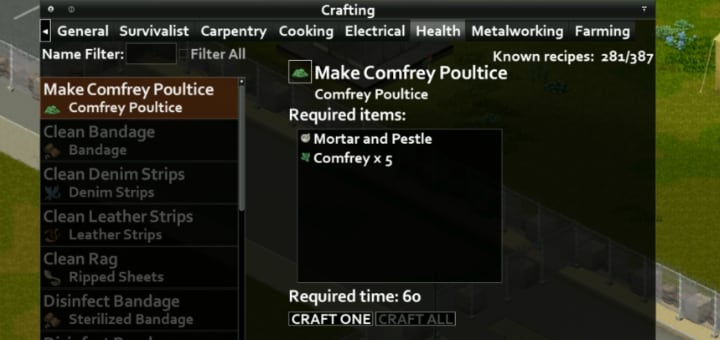
- Optional: craft Comfrey Poultice (Mortar and Pestle + 5 Comfrey) and apply it on the same fracture for an extra healing boost while it lasts.
- Keep the limb splinted until Fracture disappears. Healing time is not a fixed “few weeks”—it depends on initial severity, traits, sandbox Injury Severity, and your First Aid level.
 Splint
 Ripped Sheets
 Plank
Plank
 Tree Branch
 Wooden Stick
 Comfrey ×5
 Comfrey Poultice
 Mortar and Pestle
What a fracture does
Falls, vehicle impacts, and hard zombie hits can set a body part’s Fracture timer. While it is active the limb is injured: expect pain, restricted use of that limb (including combat and carrying), and a long natural recovery if you do nothing.
Fractures heal on their own. Treatment does not “set the bone” with a one-click cure—it raises the healing rate so the Fracture value drains much faster. In sandbox options, Bone Fracture can disable fracture injuries entirely, and Injury Severity (Low / Normal / High) changes how hard hits land and how long injuries last.
Step 1 — Apply a splint (main treatment)
Materials must be in your inventory (or the treating player’s inventory if helping someone else). Two valid options:
- Ready Splint item — loot one, or craft it first (see below).
- On the fly: 1× Ripped Sheets + 1× Plank, Tree Branch, or Wooden Stick.
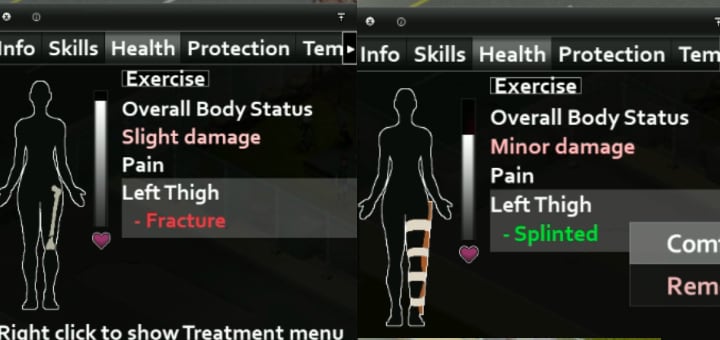
- Open Health.
- Right-click the fractured limb (the red Fracture text / body part).
- Choose Splint, then pick either the ready Splint or a wood + Ripped Sheets combination.
- Wait for the timed action. The panel should switch to a green Splinted status.
Crafting a Splint ahead of time
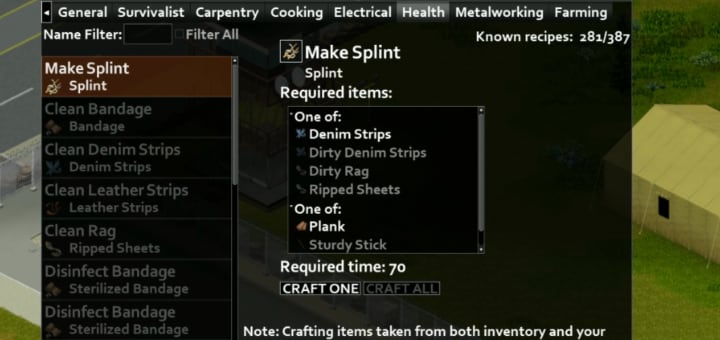
The Medical craft recipe Make Splint (in-hand, no skill book required) builds a portable Splint from:
- 1× fabric strip: Ripped Sheets, Dirty Ripped Sheets, Denim Strips, Dirty Denim Strips, Leather Strips, or Dirty Leather Strips
- 1× rigid piece: Plank, Tree Branch, or Wooden Stick
Applying from the Health menu with loose materials still expects clean Ripped Sheets plus wood. Pre-crafting a Splint is useful when you only have denim or leather strips, or when you want a finished kit in a bag. Tear clothing for Ripped Sheets using the usual rip action—see the sheets guide.
How much faster does a splint heal?
Healing speed is not a flat 10×. When you apply a splint, the speed-up scales with the treating character’s First Aid skill:
Splint factor ≈ (First Aid level + 1) ÷ 2
Compared with an unsplinted fracture, a splinted limb heals faster by a higher base rate, then multiplies by that factor. Practical relative speeds:
| First Aid level | Splint factor | Approx. speed vs no splint |
|---|---|---|
| 0 | 0.5 | ~5× faster |
| 1 | 1.0 | ~10× faster |
| 3 | 2.0 | ~20× faster |
| 5 | 3.0 | ~30× faster |
| 10 | 5.5 | ~55× faster |
So the familiar “about 10×” figure only matches roughly First Aid 1. Higher First Aid keeps paying off on every new splint you apply. The apply action also finishes a little faster at higher First Aid.
With First Aid above 4–6, the Health panel can show quality hints (for example Moderate/Severe fracture or Good/Moderate splint). Those labels help you judge the injury; they are not separate treatments.
First Aid XP — when you actually get it
Step 2 — Comfrey Poultice (extra boost)
Comfrey Poultice does not replace a splint. It adds a temporary healing boost on the body part while the poultice effect lasts. Use it after (or alongside) proper immobilization on limbs.
Recipe (Build 42.19)
- Mortar and Pestle (kept / not consumed)
- 5× Comfrey
- Output: 1× Comfrey Poultice
- Crafted as a Medical / Health surface recipe
You must know the recipe before it appears in the craft menu. Ways to unlock Make Comfrey Poultice:
- Read The Herbalist magazine
- Take the Herbalist trait (or profession paths that grant it)
- Wilderness Knowledge trait packages that include the poultice recipes
- Auto-learn at First Aid 5 or Foraging 5
Apply from the Health panel when you carry the poultice: right-click the injured part → Comfrey Poultice. Strength scales with the applier’s First Aid (higher skill → stronger average boost). Characters with Hemophobic can take panic if they treat a still-bleeding part.
Comfrey itself is commonly gathered by foraging; growing season knowledge can come from seed packets, magazines, or traits that unlock medicinal plant seasons.
What actually changes healing time
| Factor | Effect in Build 42.19 |
|---|---|
| Initial fracture severity | How large the Fracture timer starts (falls, crash force, hits). Higher starting values simply take longer at the same rate. |
| Splint + First Aid | Main controllable speed-up. Factor ≈ (First Aid + 1) ÷ 2; see table above. |
| Comfrey Poultice | Extra temporary boost while it lasts; stacks as an add-on, not a substitute for splinting limbs. |
| Fast Healer trait | Shortens generated injury/fracture duration (about ×0.6 when the injury is created). |
| Slow Healer trait | Lengthens generated duration (about ×1.8 when the injury is created). |
| Sandbox Injury Severity | Low / Normal / High scales injury impact and healing (roughly 0.5 / 1.0 / 1.5 when injuries are created). |
| Sandbox Bone Fracture | Can disable fracture injuries completely. |
| Patient age / “overall health” | Not separate fracture inputs in Build 42.19—do not plan around real-world medical padding. |
Because starting severity and multipliers vary, the old “usually several weeks” line is only a loose feel for an untreated or poorly treated break. With a high First Aid splint (and Comfrey), recovery can be dramatically shorter; with Slow Healer, high Injury Severity, and no splint, it can be much longer. Watch the Health panel until Fracture / Splinted clears rather than counting calendar weeks.
Practical tips
- Splint early on usable limbs. Even First Aid 0 is still about 5× faster than leaving the bone free.
- Let a skilled friend apply the splint in multiplayer if their First Aid is higher—the factor uses the treating player’s skill.
- Stock Ripped Sheets and sticks before roof runs or long car trips; Make Splint is cheap insurance.
- Do not expect head/torso braces. Survive with rest, pain management, and other first-aid as needed until timers expire.
- Keep treating other injuries on the same part (bleeding, infection, deep wounds). A splint does not replace bandages or stitches—see the first aid overview.
Related Articles