Project Zomboid B42 Perks: Build Templates for Real Humans
Project Zomboid B42 Perks: What Changed, What’s New, and How to Build a Survivor That Works
Build 42 turns “perks” from a comfy checklist into a commitment: XP pacing changed, skills got more specialized (hello new crafting skills), and systems like muscle strain make your Strength/Fitness/Nimble choices feel louder. If you just want a workable B42 character: pick a role (fighter, crafter, scout), take traits that support that role for day 1, and avoid “interesting” new negatives until you’ve tested them on a throwaway survivor. Jump to Quick-Start for a 5-minute setup, then keep reading for the perks that actually matter in B42 and why the old B41 meta doesn’t map cleanly anymore.
Quick-Start
 Decide what you’re trying to be in the first week: fighter,
builder/crafter, or sneak/scout.
Decide what you’re trying to be in the first week: fighter,
builder/crafter, or sneak/scout. Pick 2–3 core perks you refuse to compromise on (examples
below).
Pick 2–3 core perks you refuse to compromise on (examples
below). Spend your trait points on early-game impact, not late-game
dreams.
Spend your trait points on early-game impact, not late-game
dreams. Run a throwaway test survivor for 30 minutes to sanity-check your negatives
(especially newly-added traits).
Run a throwaway test survivor for 30 minutes to sanity-check your negatives
(especially newly-added traits). If you’re bouncing off the grind, tune per-skill XP multipliers in
sandbox instead of forcing a build that isn’t fun.
If you’re bouncing off the grind, tune per-skill XP multipliers in
sandbox instead of forcing a build that isn’t fun.
Quick core-perk ideas (mix-and-match):
-  Fighter: prioritize physical perks and anything that reduces the “one bad
swing” spiral.
-
Fighter: prioritize physical perks and anything that reduces the “one bad
swing” spiral.
-  Builder/Crafter: prioritize starting levels in the craft lanes you’ll live
in.
-
Builder/Crafter: prioritize starting levels in the craft lanes you’ll live
in.
-  Sneak/Scout: prioritize movement safety (because traversal kills as
reliably as zombies).
Sneak/Scout: prioritize movement safety (because traversal kills as
reliably as zombies).
First, what do you mean by “perks” in Project Zomboid?
Project Zomboid uses “perks” in two ways, and Build 42 makes both feel sharper:
- Perks as skills: the Strength/Fitness/Nimble/etc ladder that grows (or, in B42 discussions, can feel like it slips) with play.
- Perks as traits: character-creation positives/negatives that change your daily life.
If you treat B42 like “traits are just points and skills are inevitable,” the build will punish you—because B42 leans harder into specialization and systems that tax you when you overreach.
What changed in B42 that directly affects perk choices
1) Skills got more specialized (and new ones matter)
The dev blogs call out B42’s intent: skills are “more separated,” caps can be higher, and there are “more additional skills,” including named additions like Knapping and Carving. That’s a giant neon sign that “generalist and grind” isn’t the only path anymore. In practice, B42 asks you to pick lanes earlier and be honest about your first-week loop.
Notable named examples you can plan around: - Knapping and Carving as new wilderness-adjacent skills. - Tracking being discussed as a real, gameplay-relevant skill (following signs, not magic GPS). - Trait-level specialization like Artisan granting levels in Glassmaking and Pottery, plus recipe knowledge.
2) The XP economy is less forgiving to “trash grinding”
One of the biggest silent perk changes in B42 is that some of the old, brain-off XP faucets aren’t faucets anymore: dismantling/scrapping/ripping sheets stop being reliable “level for existing” actions. B42 nudges you toward actually doing the relevant work: crafting, building, practicing, and surviving.
Here’s the practical takeaway: perk picks that support your day-to-day loop matter more than perk picks that only pay off once you’ve set up a safe grind room.
B42 XP Reality Check (project zomboid b42 perks)
    - Don’t assume dismantling = skill XP anymore.
    - Expect more “do the craft to get the craft XP.”
    - Use per-skill XP multipliers in sandbox to tune grind, not to band-aid a bad build.
    - Books may feel different; plan to earn XP by doing, not by reading your way to competence.
3) Muscle strain/combat fatigue makes physical perks feel “loud”
Multiple B42 dev updates talk about muscle strain kicking in and combat taxing you more. Translation for build planners: your Strength/Fitness/Nimble decisions aren’t just “faster leveling,” they’re “how quickly does this run devolve into limping, panicked improvisation.”
In B42, the bad loop looks like: - you overfight → strain builds → you slow down → you get tagged → you panic → you overfight again.
So perk planning becomes pacing planning.
4) Traversal is a perk check now (not a free escape)
Sheet-rope climbing in B42 is described as depending on Strength, Fitness, Nimble, plus certain traits and even professions (e.g., Burglar) affecting odds. That turns “escape routes” into something you earn—not something you assume.
If you love the classic “second-floor base with a rope,” Build 42 asks you to either: - invest in movement-related perks, or - respect the rope like it’s a dice roll you shouldn’t take while hurt/tired.
What’s new in B42 perks (skills) you should actually care about
This is the planner’s list: perks that change what you can do in week one, not in year two.
| Skill/Perk (B42) | What it changes in practice | Who should prioritize it early |
|---|---|---|
| Tracking |
Lets you play “hunter/scout” in a way that isn’t just vibes—B42 talks about following real signs | Scouts, wilderness survivors, MP reconnaissance |
 Knapping Knapping |
Enables stone-age style crafting lanes; good when “metal isn’t free” | Backwoods starts, low-loot runs, roleplayers |
 Carving Carving |
Another wilderness-adjacent craft lane; pairs with scavenging and long-term sustainability | Builders who start poor and stay mobile |
 Glassmaking / Pottery (via Artisan) Glassmaking / Pottery (via Artisan) |
Trait-driven specialization that fast-forwards specific crafting competence | Base builders, dedicated crafters, MP economy roles |
| Strength / Fitness / Nimble (movement/combat) |
Affects more than swing speed: traversal risk, stamina spiral, and “can I safely disengage?” | Everyone—especially solo and loot-runners |
Trait/“perk” picks: what B42 makes risky (and why)
B42 isn’t just “different”—it’s a build that keeps moving. Players repeatedly note trait balance shifting, and B42 patch notes add new trait pitfalls.
The new-trait trap mindset
The Motion Sensitive trait is a perfect example of why B42 trait picks need a “test first” rule. Patch notes introduced it, and players quickly reported that it can be brutal in practice. That’s not a morality play about “don’t min-max”—it’s a simple survival rule:
If a negative trait’s downside can cascade (sickness → weakness → slower escape), don’t take it on a long-run character until you’ve stress-tested it.
“Free points” aren’t guaranteed anymore
B42 chatter calls out trait nerfs, and the dev updates themselves hint at rebalancing—Smoker being called out as not the old easy-mode pick, for instance. Don’t build a character around a points exploit you remember; build around what you’ll be doing in the first 10 hours.
Perk priorities that actually move the needle (cheat sheet)
| Goal | Early-game perk focus | Why it matters in B42 |
|---|---|---|
| Safer disengages | Fitness + Nimble | Muscle strain/combat fatigue punishes long fights; you need clean exits |
| Vertical safety | Strength/Fitness/Nimble + movement-friendly traits | Rope climbs and traversal are described as skill-influenced, not guaranteed |
| Sustainable crafting | Start with levels in your craft lane (e.g., Artisan) | Skills are more separated; early levels unlock real capability faster |
| Less grind pain | Sandbox per-skill XP multipliers (if needed) | B42 trims “junk XP”; tune the grind instead of forcing it |
| Stable shooting | Aiming-adjacent improvements + practice | Late B42 notes mention aiming improvements; still expect iteration |
Three survivor templates you can actually run in B42
These are templates, not commandments. Build 42 changes—so treat them like loadouts you can patch.
1) “The Rope-Climber” (movement-first urban survivor)
project zomboid b42 perks — Rope-Climber template
    Core: Strength/Fitness/Nimble focus
    Play loop: loot → quick fights → disengage early → avoid strain spirals
    Base: second-floor safehouse, but treat rope like a skill check
    Avoid: brand-new negative traits you haven’t tested
2) “The Artisan” (craft specialist / MP economy role)
project zomboid b42 perks — Artisan template
    Core: Artisan (Glassmaking/Pottery levels + recipes)
    Play loop: secure tools → craft value → build base infrastructure
    Team value: turns scavenged junk into long-term utility
    Avoid: combat-heavy starts without a buddy or an escape plan
3) “The Tracker” (wilderness scout)
project zomboid b42 perks — Tracker template
    Core: Tracking + wilderness craft lanes (Knapping/Carving)
    Play loop: travel light → read the environment → pick battles → relocate often
    Best for: low-loot runs, nomad play, MP scouting
    Avoid: “stand and fight everything” mentality
Movement perks matter: a quick visual reminder
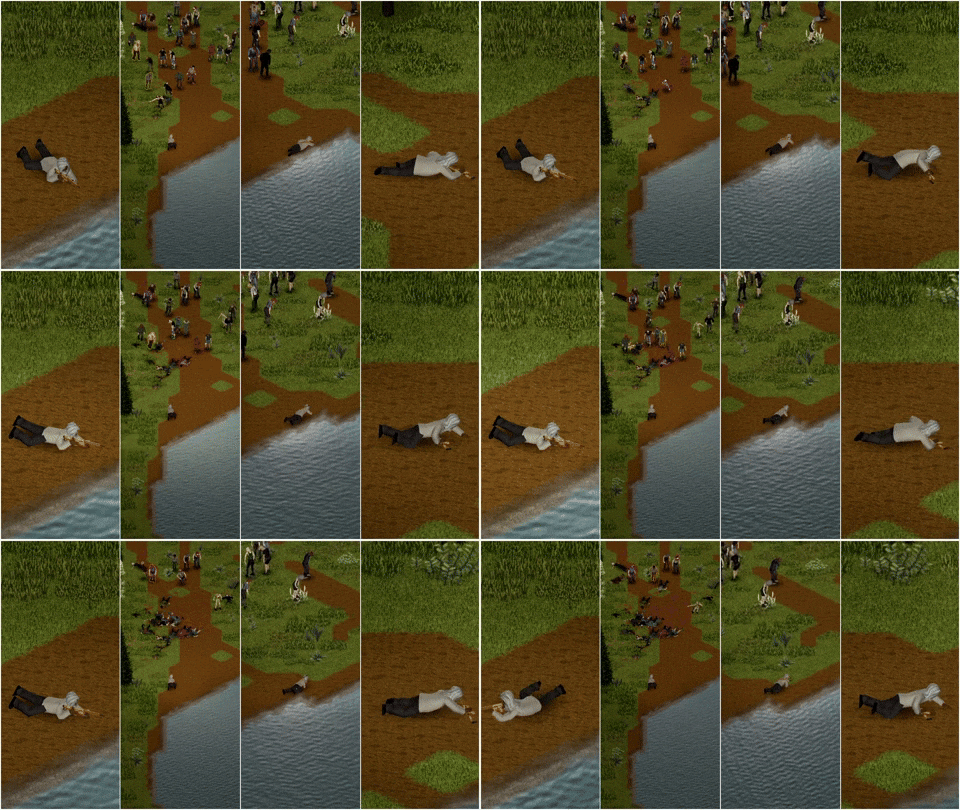
B42’s vibe is “the world is physical.” If you treat movement like a menu option instead of a survivable action, you’ll feel it—especially when fatigue/strain stack up. Build around moving safely, not just hitting hard.
Traits vs gear: don’t forget the “item perks”
One underrated B42 habit: when trait balance is shifting, gear can be your stabilizer. Night/visibility is a classic example—sometimes you don’t need to spend precious trait points if you can solve a problem with equipment and planning.

That doesn’t mean traits are irrelevant. It means you should ask: - “Is this trait saving my life on day 1?” - “Or is it a convenience I could replace with gear, routines, or teammates?”
The B42 perk mindset that keeps runs alive (even while the build changes)
Here’s the veteran-magazine version: Build 42 is less about building a superhero, more about building a job.
Pick your job: - You fight (and you respect strain). - You build (and you start with competence). - You scout (and you stay alive long enough to matter).
Then you support that job with perks, not with nostalgia.
I learned this the hard way in a test run: I played B42 like it was B41, tore apart half a neighborhood expecting the usual “free XP,” and then realized I’d basically been doing cardio with a screwdriver. The moment I stopped chasing the grind and started chasing a role, the build clicked—and the game stopped feeling like it was “randomly harder.”
Action Steps Recap: Pick a role, lock in 2–3 core perks, test risky traits, tune per-skill XP multipliers if needed, and pace combat to avoid strain spirals.
Patch-History
Show patch history
| Date | Change Note | Impact on early-game priorities |
|---|---|---|
| 2026-01 | Initial draft | Establishes B42 perk mindset, key systems, and three starter templates |
| 2026-01-12 | Cleanup pass | Removed internal drafting notes from the patch history section |